A Brief History of Painted Post

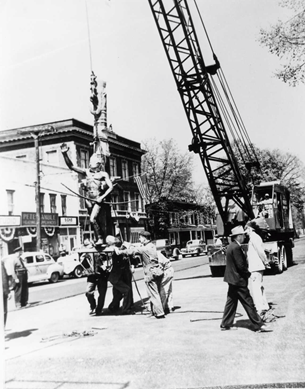
In spring of 2018 the Indian Monument was reconditioned, the red Painted Post was relocated and completely rebuild and relocated across the street behind the statue, also the Pickering Monument also reconditioned and relocated to the left of the Indian.
In 1779 General John Sullivan made his expedition into Indian territory. Soon after the Revolutionary War, emigration began to penetrate Western New York from three areas: Pennsylvania, New England, and the Mohawk Valley.
Arthur Erwin from Bucks County, Pennsylvania, rode up to the Indians’ Painted Post, in July 1789. Early settlers Samuel Harris and Frederick Calkins had preceded him. Arthur Erwin rode up the mountain on the south bank of the river to obtain a view of the unrivaled valleys of the Chemung, Tioga and Cohocton. He was driving cattle to Canandaigua. He gave orders to his drovers to hasten their arrival at Canandaigua. When he go there he proceeded to the land office and inquired if Township #2 of the Second Range was on the market, and if so, what was the price? The answer was, “It is for sale and the price is 1400 pounds in New York currency.” For the area of land containing 22,040 acres, Col. Erwin gave his drove of cattle and paid the balance in money. Within twenty-four hours of Col. Erwin receiving his deed, Col. Eleazer Lindsley arrived and made an offer on the same township. He subsequently purchased the Town of Lindley.
The Town of Painted Post was first organized on April 5, 1791, and comprised the territories of Hornby, Corning, Caton, Campbell, Erwin, Lindley, Tuscarora, Addison, and Thurston. When Steuben County was organized in March 1796, the Town of Painted Post was reduced to the first six towns and they were called ranges. Corning was the last township to bear the name of Painted Post and retained it until 1850. Now the name of Painted Post is applied only to the beautiful village which clusters around the site of the Indian replica of a painted post which once gave name to the whole area. The citizens of the Village of Painted Post take pride in the name, perpetuating the name with a replica of the post and a statue of Chief Montour adjacent. Norman Phelps designed the Indian monument which was erected in 1950. A citizens’ subscription drive headed by E.J. Smith financed that project. Today, a different Indian replica stands proudly in the Village Square. An earlier Indian replica has been restored and resides in the Village Hall.
Warren Stone Hodgman lived in Painted Post starting in 1850, and died aged 78 in 1903. He was a farmer as well as proprietor of a saw mill and a grist mill. Because he was successful in business and community affairs, Hodgman Park is a memorial to his life.
A railroad depot, built in the spring of 1873 may be the depot on the corner of Steuben Street and Victory Highway. There was another depot in earlier days.
The Village voted to incorporate on April 22, 1893. The Village incorporation papers were recorded in the Steuben County office in Bath on April 25, 1893. It was recorded in Albany in May, 1893. At that time, the Village of Painted Post encompassed 683.62 acres. The Village limits were extended on October 13, 1916 with the total area becoming 787.73 acres. Currently, the size of the Village is 1.25 square miles, much smaller than it was originally.